
luchtfotografie Henderyckx Izegem
home
Excursions
Wednesday,
21 September (13.00-18.00)
Thursday, 22 September
(13.00-18.00)
Postconference
tours
Friday, 23 September
(14.00-18.00)
Saturday, 24 September
(09.30-18.00)
Belgium has a
short (65 km) coastline with a wide variety of rather small natural habitat
fragments scattered amid the infrastructure of four harbours, ten coastal
villages or towns and an important tourism industry. As such it provides ample
opportunities to visit various nature restoration and management projects at
close range. Two technical excursions will be organized during the event:
Wednesday, 21 September
(13.00-18.00)
Half-day visit of the IJzer Estuary and guided tour of the achievements of the
LIFE 'FEYDRA' project ('Fossil Estuary of the IJzer Dunes Restoration Action'),
including the Hannecart woodland dunes and the waterworks station of the local
water company IWVA.
Thursday, 22 September
(13.00-18.00)
Half-day visit of the 'green beach' project at the
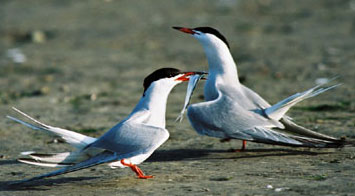
Baai van Heist, Europe's most important tern breeding site in the harbour of
Zeebrugge, and neighbouring nature restoration activities.
Tern island
|
luchtfotografie Henderyckx Izegem |
By the end of the 1990s, a small peninsula (2-3 ha) was created along the eastern breakwater of the Zeebrugge harbour. This was the first of a series of measures to compensate for the loss of nesting habitat in the western part of the harbour. During the next five years, the peninsula was further enlarged in four steps and during the breeding season in 2005 it measured about 10 ha. The peninsula was meant to attract terns and was therefore named the 'tern peninsula'. In order to offer suitable nesting habitats to the different tern species, it had to meet several preset ecological conditions that were abstracted from literature. |
| The lower parts of the peninsula were covered with a 5 cm layer of shell material to make them suitable for Little Terns. To minimize erosion and to support quick colonization by Black-headed Gulls L. ridibundus the higher parts were implanted with salt-resistant grasses. Most parts of the peninsula, however, were not implanted because earlier experience in raised terrain showed that the area will become suitable for Common Terns within a few years. No specific measures were taken to attract plovers because it was assumed that the parts developed for Little Terns were also suitable for those species. At about the same time the adjacent Flemish Nature Reserve 'Baai van Heist' was established and closed for the public during the breeding season from 1998 onwards. Further info on: http://www.birdlife.net/news/news/2004/08/belgian_terns.html and on: http://www.vogelbescherming.nl/print_default.aspx?cid=1331 | |
Postconference tours
Two optional post-conference excursions are planned (provided a minimum number of 20 participants is reached).
Friday, 23 September
(14.00-18.00)
We will visit either the Zwin
nature reserve, with its dunes and salt-marshes in the mouth of the Schelde
Estuary, or the LIFE-Nature project in the historical polder landscape of
Uitkerke. The former is probably the most popular nature reserve in Belgium and
is facing a dramatic silting-up, prompting large-scale management activities. In
the polders of Uitkerke, hundreds of hectares of historical grassland have been
purchased and several nature restoration measures have been implemented.
Saturday, 24 September
(09.30-18.00)
Daytrip to the dune areas of De Panne (Belgian west coast) and Ghyvelde
(northern France), with a focus on various nature restoration activities in
dunes of different structure, historical background and ecological
characteristics.