VLIZ
VLAAMS INSTITUUT VOOR DE ZEE
MARIEN EN KUSTGEBONDEN ONDERZOEK & BELEID IN VLAANDEREN
   
© M.Decleer © M.Decleer © M.Decleer © VLIZ ©
 
 
  English  Sitemap  Print
U bent hier: VLIZ > Infoloket
menu1 Over het VLIZ menu2 Infoloket menu3 Zeebibliotheek menu4 Cijfers&Beleid menu5 Faciliteiten menu6 Datacentrum
   
Infoloket

The expedition

The expedition started on 13 June 2006 (08.00) in Brest (France) and ended on 20 June 2006 (16.00) in Cork (Ireland). Follow the research vessel 'BELGICA' online at BELGICA ODAS DATA. Daily reports on the activities on board are available in our log book.

Responsible scientists: Prof. Dr. J.-P. HENRIET, Dr. D. VAN ROOIJ
Participation institutes: RCMG - Ghent University, University College Cork (Ireland), IFREMER (France).


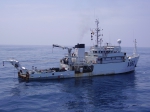
BELGICA


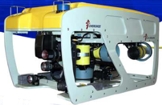
Cherokee ROV (Remotely Operated Vehicle)
Within the framework of the EC IP FP6 HERMES project, RCMG tested for the first time its ROV on several coral-rich sites along the Celtic Margin (Area 1) and the Porcupine Basin (Area 2). The La Chapelle Bank (Celtic Margin) and adjacent canyons were earlier recognized by Zibrowius and Le Danois as a “hotspot” of deep-water corals. In the Porcupine Basin, Thérèse mound as well as the Moira mounds are revisited for an extra visual reconnaissance. Also the recently drilling IODP expedition 307 sites will be revisited for additional high-resolution seismic profiling.

You may download the technical details of our ROV: Cherokee and the ROV Tether Management System (TMS) (the ROV's garage) here.

This campaign was executed in cooperation with the department DRO-DEEP/LEP of IFREMER (France), University College Cork (Ireland) and the National Oceanography Centre Southampton (United Kingdom).

This campaign focussed on the following topics:

  • La Chapelle Bank (Area 1): first test and deployment site for the ROV. Visual observations was supported with multibeam mapping and high-resolution seismic profiling. Current information through the water column was obtained with the hull-mounted ADCP
  • Porcupine Seabight (Area 2): ROV observation dives within the vicinity of Thérèse mound and the Moira mounds. Current information through the water column was obtained with the hull-mounted ADCP
  • Additional high-resolution seismic profiling of previously drilled IODP sites
  • Additional high-resolution seismic profiling of the Enya mounds and associated pockmark field

The two study areas are located on respectively the Celtic Margin and the Porcupine Seabight, at water depths between 250 and 1000 m depth.
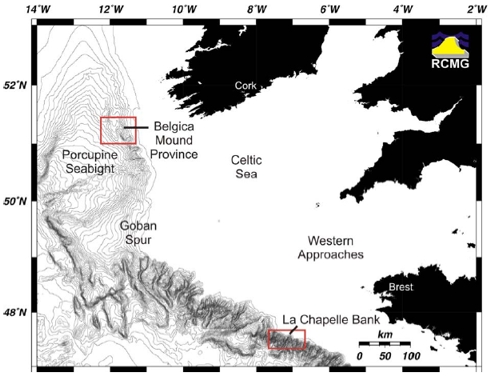
  • Area 1 is located in the vicinity of the La Chapelle Bank (7°45’W/6°30’W/47°30’N/47°45’N)
  • Area 2 is located in the Porcupine Seabight, comprising the Moira mounds, Thérèse mound and the Enya mounds (12°15’W/11°05’W/51°N/51°30’N)


Study area 1 and 2

Operations:

  1. Multibeam reconnaissance coverage within area 1
  2. ROV operations Area 1: testing of equipment and seabed observations on selected locations (to be concreted after multibeam survey)
  3. Seismic survey of Area 1
  4. ROV operations Area 2: seabed observations along selected tracks or on locations (to be concreted on board)
  5. Seismic survey of Area 2


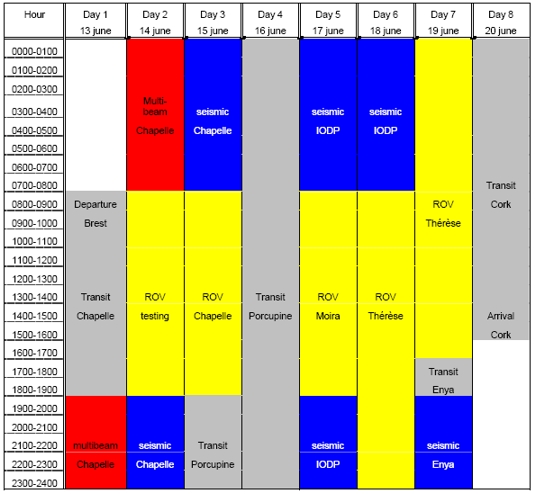
Planning schedule

Download full cruise report (PDF).


Vlaams Instituut voor de Zee
InnovOcean site
Wandelaarkaai 7
B-8400 OOSTENDE, België
Tel: +32 [0]59/34 21 30
Fax: +32 [0]59/34 21 31
Email: info@vliz.be


Vlaamse Gemeenschap Provincie West-Vlaanderen