Long term trends in the macrobenthos of the Belgian Continental Shelf
| MACROBEL Long term trends in the macrobenthos of the Belgian Continental Shelf |
| Introduction | Methods | Taxonomy | Distribution | Project info | Atlas |
Macrobel taxon detailsPariambus typicus (Krøyer, 1845)
 101857 (urn:lsid:marinespecies.org:taxname:101857)
accepted
Species
marine,
recent only
(of ) Krøyer, H. (1845). Karcinologiske Bidrag. <em>Naturhistorisk Tidsskrift Ser. II.</em> 1: 283-345, pls. 2-3. [details]

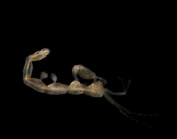
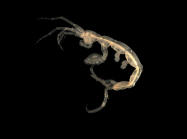
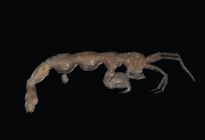
Description Ghost shrimps are characterised by a slender, cylindrical body with less appendages than other
amphipods. The males are...
Description Ghost shrimps are characterised by a slender, cylindrical body with less appendages than other amphipods. The males are large and slender whereas the females are stockier. Up to 7 mm long, elongate and transparent body clearly separated into segments. Central segments have rudimentary legs. [details] Distribution In the 1976-1986 period Pariambus typicus was found across the entire Belgian part of the North Sea with a low distribution...
Distribution In the 1976-1986 period Pariambus typicus was found across the entire Belgian part of the North Sea with a low distribution frequency. In the 1994-2001 period the distribution frequency increased but the distribution was limited to the near-coastal zone, with the exception of the eastern costal zone. The density levels increased as well: from a maximum of 220 ind./m2 in the 1976-1986 period to a maximum of 15,000 ind./m2 in the 1994-2001 period. [details]
Horton, T.; Lowry, J.; De Broyer, C.; Bellan-Santini, D.; Coleman, C.O.; Corbari, L.; Costello, M.J.; Daneliya, M.; Dauvin, J.-C.; Fišer, C.; Gasca, R.; Grabowski, M.; Guerra-García, J.M.; Hendrycks, E.; Hughes, L.; Jaume, D.; Jazdzewski, K.; Kim, Y.-H.; King, R.; Krapp-Schickel, T.; LeCroy, S.; Lörz, A.-N.; Mamos, T.; Senna, A.R.; Serejo, C.; Sket, B.; Souza-Filho, J.F.; Tandberg, A.H.; Thomas, J.D.; Thurston, M.; Vader, W.; Väinölä, R.; Vonk, R.; White, K.; Zeidler, W. (2021). World Amphipoda Database. Pariambus typicus (Krøyer, 1845). Accessed through: Long term trends in the macrobenthos of the Belgian Continental Shelf (Macrobel) at: http://www.vliz.be/vmdcdata/macrobel/aphia.php?p=taxdetails&id=101857 on 2024-04-25
Long term trends in the macrobenthos of the Belgian Continental Shelf (Macrobel). Pariambus typicus (Krøyer, 1845). Accessed at: https://www.vliz.be/vmdcdata/macrobel/aphia.php?p=taxdetails&id=101857 on 2024-04-25
Date action by
original description
(of ) Krøyer, H. (1845). Karcinologiske Bidrag. <em>Naturhistorisk Tidsskrift Ser. II.</em> 1: 283-345, pls. 2-3. [details]
context source (Schelde) Janssen, C.R.; Ghekiere, A.; Verslycke, T.; Vincx, M.; Fockedey, N.; Rappé, K.; De Brabander, H.; Noppe, H.; Roose, P.; Monteyne, E.; Vethaak, D.; Mees, J.; Deneudt, K. (2007). Endocrine disruption in the Scheldt estuary distribution, exposure and effects (ENDIS-RISKS). <em>Final report. Belgian Science Policy: Brussels.</em> 106 pp. (look up in IMIS) [details] context source (BeRMS 2020) Bio-environmental research group; Institute of Agricultural and Fisheries research (ILVO), Belgium; (2015): Macrobenthos monitoring in function of the Water Framework Directive in the period 2007-2009. [details] basis of record Bellan-Santini, D.; Costello, M.J. (2001). Amphipoda. <em>in: Costello, M.J. et al. (Ed.) (2001). European register of marine species: a check-list of the marine species in Europe and a bibliography of guides to their identification.</em> Collection Patrimoines Naturels 50: pp. 295-308. (look up in IMIS) [details] additional source Bachelet, G.; Dauvin, J.-C.; Sorbe, J. C. (2003). An updated checklist of marine and brackish water Amphipoda (Crustacea: Peracarida) of the southern Bay of Biscay (NE Atlantic). <em>Cah. Biol. Mar.</em> 44(2): 121-151. (look up in IMIS) [details] Available for editors  additional source Muller, Y. (2004). Faune et flore du littoral du Nord, du Pas-de-Calais et de la Belgique: inventaire. [Coastal fauna and flora of the Nord, Pas-de-Calais and Belgium: inventory]. <em>Commission Régionale de Biologie Région Nord Pas-de-Calais: France.</em> 307 pp., available online at http://www.vliz.be/imisdocs/publications/145561.pdf [details] additional source Hayward, P.J. & J.S. Ryland (Eds.). (1990). The marine fauna of the British Isles and North-West Europe: 1. Introduction and protozoans to arthropods. <em>Clarendon Press: Oxford, UK.</em> 627 pp. (look up in IMIS) [details] Available for editors  Present Inaccurate Introduced: alien Containing type locality Present Inaccurate Introduced: alien Containing type locality
From other sources
Description Ghost shrimps are characterised by a slender, cylindrical body with less appendages than otheramphipods. The males are large and slender whereas the females are stockier. Up to 7 mm long, elongate and transparent body clearly separated into segments. Central segments have rudimentary legs. [details] Distribution In the 1976-1986 period Pariambus typicus was found across the entire Belgian part of the North Sea with a low distribution frequency. In the 1994-2001 period the distribution frequency increased but the distribution was limited to the near-coastal zone, with the exception of the eastern costal zone. The density levels increased as well: from a maximum of 220 ind./m2 in the 1976-1986 period to a maximum of 15,000 ind./m2 in the 1994-2001 period. [details] Habitat Pariambus typicus is observed in fine to coarse-grained sediments (median grain size 100 to 500 μm) with a maximum mud content of 40%. Preference is given to sediments with a median grain size of 150 to 250 μm (relative occurrence: > 30%) and a mud content of 10 to 40% (relative occurrence: up to 60%). [details]
|