The Flanders Marine Institute (VLIZ) was honoured to welcome Teresa Ribera, European Commission Executive Vice-President for a Clean, Just and Competitive Transition and European Commissioner for Competition, to Ostend on Friday 13 November. During her visit, she gained first-hand insight into the scientific expertise, innovative technologies and international partnerships through which VLIZ contributes to OceanEye, the European initiative aimed at strengthening ocean observation across Europe.
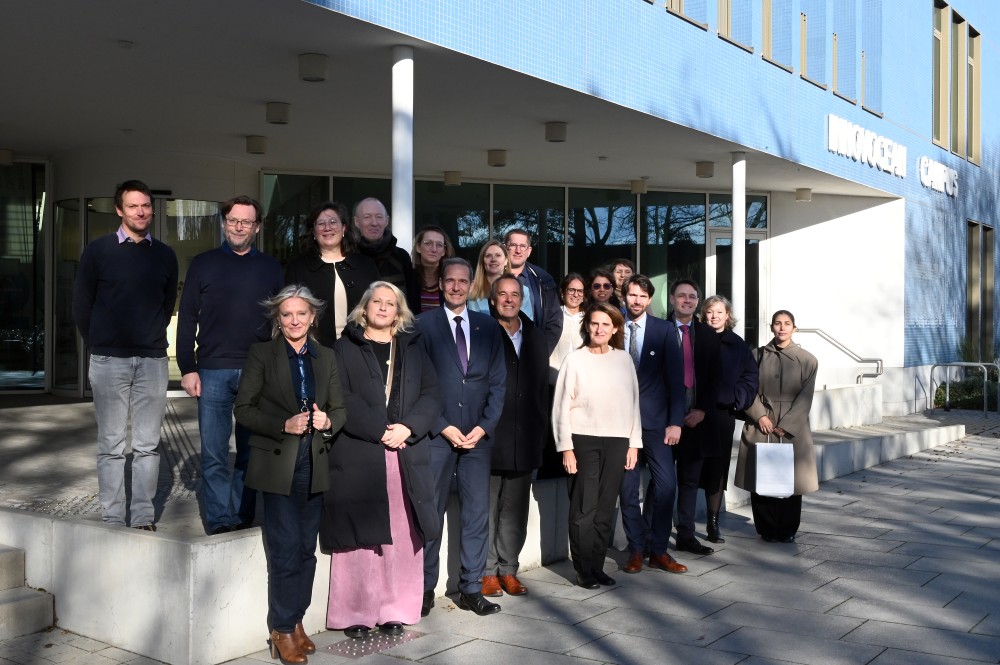
Executive Vice-President Teresa Ribera’s visit took place in the presence of Koen Surdiacourt, Acting Governor of West Flanders and Chair of VLIZ; Thomas de Béthune, Head of the European Commission Representation in Belgium; Gaëtan Poelman, from the Permanent Representation of Flanders to the EU; and John Crombez, Mayor of Ostend.
How do we monitor the health of our ocean? What role do autonomous observation systems, research vessels and advanced data systems play? And how can we translate the knowledge gained into effective European ocean policies? These questions were at the heart of European Commission Executive Vice-President Teresa Ribera’s visit to VLIZ.
From research vessels and underwater robots to data for policy and innovation
During a tour of VLIZ's research facilities, Executive Vice-President Ribera gained first-hand insight into the wide range of technologies the institute uses to advance our understanding of the ocean.
On board the Flemish research vessel RV Simon Stevin, she discovered how scientists use specialised instruments to continuously collect data about the marine environment. At the VLIZ Science Harbour and Marine Robotics Centre, she was introduced to innovative uncrewed vessels and underwater robots that enable ocean observations in places and at times that are difficult to reach using conventional research methods.
The visit also included the VLIZ laboratories, where advanced techniques are used to study marine biodiversity, monitor changes in the marine environment and assess the health of the ocean.
OceanEye: turning ocean data into better policies
The visit focused on OceanEye, a strategic European Commission initiative that plays a key role in implementing the European Ocean Pact. Through OceanEye, Europe aims to establish a coherent, operational ocean observation system that connects existing national, European and international research infrastructures, observations, data flows and services. Beyond making reliable ocean data more accessible to scientists, policymakers and society, the initiative also seeks to strengthen Europe's global leadership, technological innovation, competitiveness and strategic autonomy in ocean observation.
VLIZ contributes to these ambitions in several ways. As a scientific institute, it combines its own ocean observations with the development of innovative monitoring and analytical technologies. At the same time, it plays an important role in managing, standardising and facilitating the international exchange of marine data and information.
Through European and international partnerships, VLIZ helps turn ocean data into valuable, policy-relevant knowledge. This is essential for informed decision-making on issues such as biodiversity conservation, climate change and the sustainable use of the ocean.
Collaboration is key to sustainable ocean governance
The ambitions of OceanEye extend beyond technology and data collection. International cooperation, innovation, knowledge sharing and public engagement are equally essential to putting the European Ocean Pact into practice.
VLIZ's expertise and research infrastructure are closely aligned with OceanEye's ambitions, providing valuable opportunities to contribute to the further development of an integrated European ocean observation system.
The importance of international collaboration was further highlighted during a concluding discussion at the InnovOcean Campus. Representatives of the local and international organisations based on the campus, including the secretariats of EMODnet and the European Marine Board, and the IOC Project Office for IODE, discussed the role of science, innovation and partnerships in achieving Europe's ocean ambitions.
Recognition of Flanders' contribution
Executive Vice-President Ribera's visit represents an important recognition of VLIZ's contribution to Europe's ocean ambitions.
Jan Mees, Director of VLIZ, commented: "We are honoured by Executive Vice-President Teresa Ribera's interest in the marine research and innovation taking place here in Ostend, which are helping to shape the future of ocean observation. Her visit gave us an opportunity to showcase VLIZ's role across the entire marine knowledge value chain – from collecting observations at sea to transforming ocean data into policy-relevant information products that support informed policymaking and decision-making."