Today’s climate, ocean and biodiversity policy frameworks are not ready to regulate ocean-based carbon removal techniques. This is the main outcome of a new VLIZ policy informing brief which demonstrates that marine carbon, as a transversal element between climate policy, biodiversity conservation, and the blue economy, is structurally underrepresented across these policy domains. A key step towards a more objective and integrated approach to marine carbon lies in the development and application of robust monitoring, reporting, and verification methodologies, as well as consistent carbon accounting systems. Such instruments are essential for quantifying the role of marine carbon and correctly integrating it into policy making. The policy informing brief is developed within the framework of the BERNARDO project (ICON), which sets out to produce a detailed carbon budget for a shelf sea.
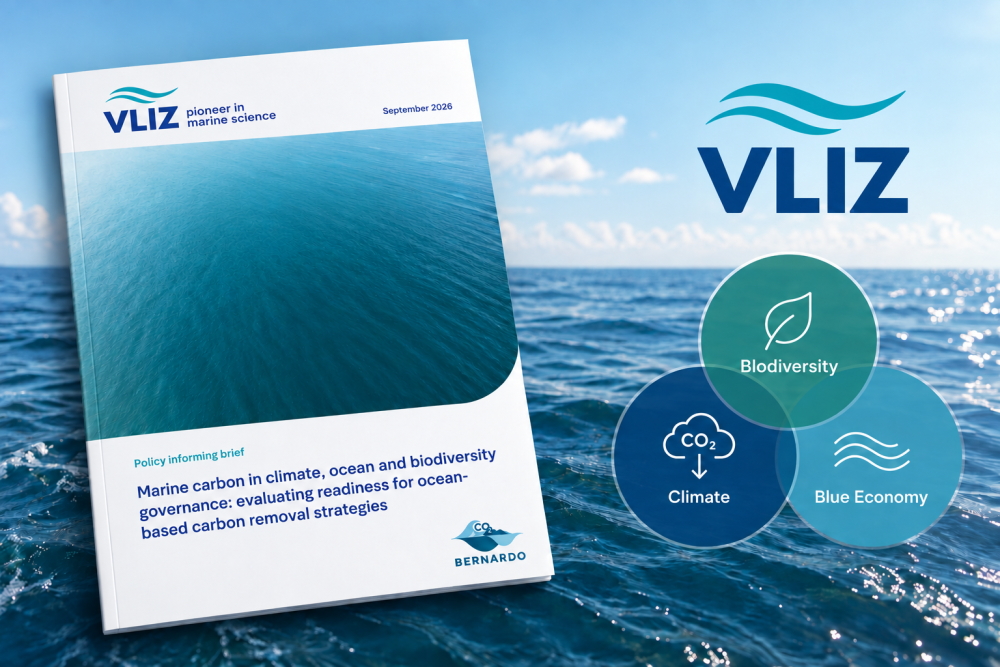
AI generated image
Given the recognition that global warming will no longer remain within the targets of the Paris Agreement (limiting warming to +1.5 to 2°C), attention is increasingly turning to complementary climate strategies that can effectively contribute to reducing atmospheric CO₂ concentrations. Ocean-based carbon dioxide removal techniques (mCDR techniques) are among the options being explored in this context. These techniques are generally divided into two categories. On the one hand, there are nature-based approaches, such as the restoration and creation of so called coastal blue carbon ecosystems (carbon-rich coastal ecosystems like mangroves, salt marshes, and seagrass meadows). These interventions are relatively well suited to local-scale implementation and are more amenable to monitoring and evaluation. On the other hand, there are techniques aimed at actively intervening in marine biogeochemistry to enhance the ocean’s carbon uptake capacity. For these more technological approaches, there remains considerable uncertainty, both regarding their effectiveness and scalability and regarding their ecological impact and societal support.
The operationalisation of ocean-based carbon removals therefore requires policy frameworks capable of assessing ecological, economic, and climate-related interests in an integrated and balanced manner. Against this background, VLIZ examined the extent to which existing policy frameworks already fulfil this role, with particular attention to how they treat marine carbon as a key element at the intersection of climate, nature, and the blue economy.
The analysis shows that none of the current policy domains are fully capable to adequately regulate marine carbon and ocean-based carbon dioxide removal. Climate policy frameworks typically define the scope and prioritse standardised carbon budgeting and emissions inventories, but they integrate marine carbon primarily in the context of coastal blue carbon ecosystems. Ocean and biodiversity frameworks, by contrast, focus mainly on spatial planning, ecosystem management, and limiting human impacts. They recognise the role of marine carbon mostly indirectly, which in practice often leads to the application of the precautionary principle to engineered carbon removal techiques.
The underlying challenge is the fact that the ocean is a vast, dynamic, and transboundary system, which substantially complicates the development of integrated policy frameworks and standardised monitoring protocols. As a result, marine carbon, except for the well-defined coastal blue carbon ecosystems, does not yet form a structural component of greenhouse gas inventories, climate mitigation strategies, or carbon market mechanisms.
Given this context, this policy brief not only provides insight into the current bottlenecks in the regulation of ocean-based carbon removals, but also outlines recent international and European developments that signal a growing recognition of the role of marine carbon. In addition, it presents arguments for the development of a more integrated ocean policy supported by widely accepted and scientifically robust monitoring and verification systems. Such a framework could contribute to more coherent ocean governance where climate mitigation, nature conservation, and a sustainable blue economy are brought together in an integrated and evidence-based way.
This policy brief was prepared within the framework of the BERNARDO-project (Linking Blue Economy with Marine Carbon Budgets through Observations; VLAIO 2023–2027). BERNARDO aims to produce a detailed quantification of the marine carbon budget for a continental shelf system, the Belgian North Sea. In doing so, the project establishes a major advance in the quantification of marine carbon budgets, and helps bridge the gap between these budgets and applications within the Blue Economy.
Interested in this policy brief?
Dauwe, S.; Verleye, T.J.; Pirlet, H.; Chisala, C. (2026). Marine carbon in climate, ocean and biodiversity governance: Evaluating readiness for ocean-based carbon removal strategies. VLIZ Beleidsinformerende Nota's, 2026_002. Vlaams Instituut voor de Zee (VLIZ): Oostende. 101 pp. https://dx.doi.org/10.48470/139
Download
Contact
Steven Dauwe: steven.dauwe@vliz.be; beleid@vliz.be