KPI 3
Seven missions a year conducted with the vehicles and equipment of the Marine Robotics Centre. This number includes the multiple-day deployment of equipment over four consecutive days.
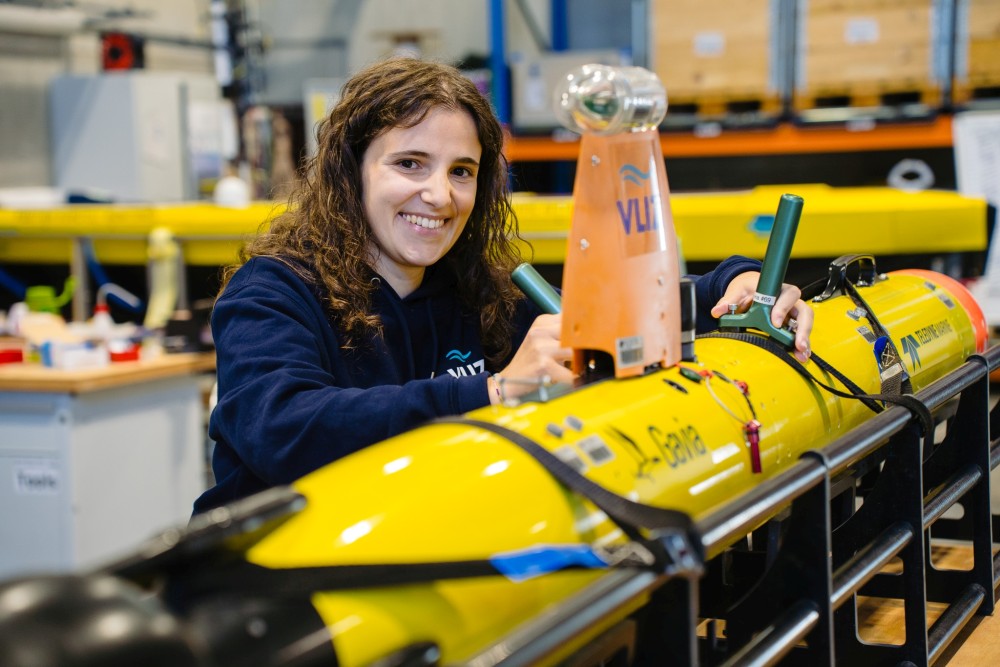
Autonomous Underwater Vehicle (AUV) Barabas is a torpedo-shaped robot which performs measurements of the water column, the seabed and the soil. It is capable of diving to a depth of 1300 metres and can remain submerged for up to 7 hours. The robot is ideally suited for mapping the seabed and heritage shipwrecks. Unmanned Surface Vehicle (USV) Adhemar exploits wave power for its propulsion while solar panels provide electricity for its measuring instruments. Since the power supply is largely dependent on renewable energy, the USV can perform measurements of water and atmosphere over long periods of time. Gliders Yoko (transferred by Vrije Universiteit Brussel (VUB) to VLIZ in 2021) and Tsuno (newly acquired in 2024) are ideally suited for studying climate change in the ocean and conducting research into micronutrients in the ocean. At 9 metres in length, the USV Gobelijn can be considered a small research vessel. It is equipped with scientific instruments and sensors, and features a unique system for launching and retrieving other robots. The vessel can carry out scientific measurements at sea for several days or even weeks at a time. The USV Gobelijn will pave the way for increased observation, research and innovation at sea, with fewer crew members and a smaller carbon footprint.