The Key Performance Indicators (KPIs) refer to important services provided by VLIZ to marine scientific researchers, policymakers, educators and the general public. These are criteria to evaluate the operation of VLIZ. As stated in the covenant for the period 2022-2026, VLIZ has to deliver on at nine KPIs every year and qualitatively report on three supplementary indicators.
KPI 1
At least 90 (the average figure for 2020–2022) new or updated data sets published in Open Access.
A great deal of data are collected within the scope of Flemish marine research. Data supplied to VLIZ are archived and – with permission of the data owner – integrated into data systems or processed into data products so that they can be efficiently disclosed. To facilitate the search for data, VLIZ provides a detailed description of the data in data sets and discloses them via an online information system.
KPI 2
At least 200 sailing days spent on scientific research, monitoring and education each year.
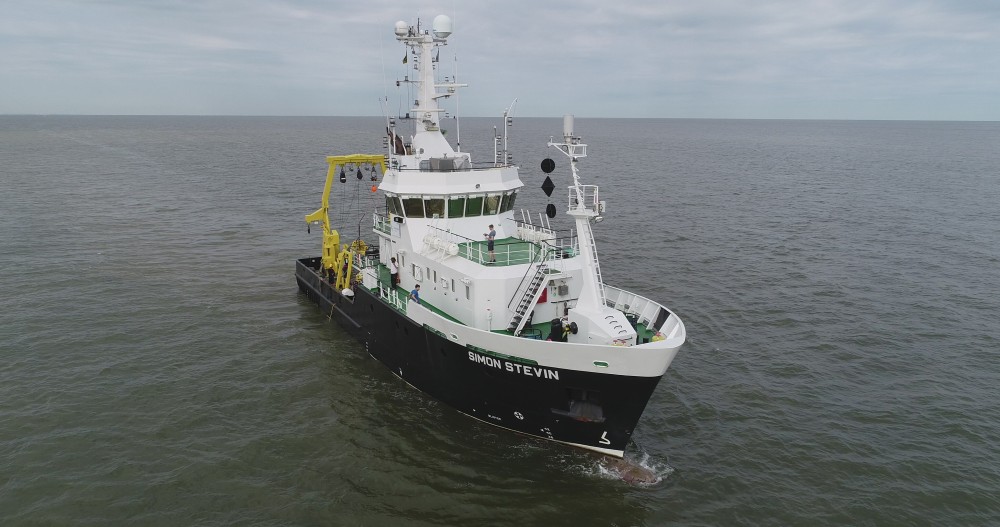
VLIZ provides researchers with logistical support by ensuring the management, maintenance and operation of research infrastructure and equipment. RV Simon Stevin is deployed for academic coastal oceanographic research in the Southern Bight of the North Sea and the eastern part of the English Channel. It also serves as a training platform for students from marine sciences as well as maritime training courses. In 2022, a total of 1145 people, including 800 scientists/divers and 345 students, boarded the ship. Eight marine research groups made use of RV Simon Stevin within the scope of 25 different projects. RIB Zeekat can be deployed from the research vessel Simon Stevin or from the shore, including for sampling in coastal waters, the Belgian ports and the Scheldt estuary. The reinforced keel is designed to run the vessel aground on tidal banks.
KPI 3
Seven missions a year conducted with the vehicles and equipment of the Marine Robotics Centre. This number includes the multiple-day deployment of equipment over four consecutive days.
Remotely Operated Vehicle (ROV) Zonnebloem (formerly called ‘Genesis’) is deployed for national research in the Belgian part of the North Sea and for deep-sea research from international research vessels. Autonomous Underwater Vehicle (AUV) Barabas is a torpedo-shaped robot which performs measurements of the water column, the seabed and the soil. It is capable of diving to a depth of 1300 metres and can remain submerged for up to 7 hours. The robot is ideally suited for mapping the seabed and heritage shipwrecks. Unmanned Surface Vehicle (USV) Adhemar exploits wave power for its propulsion while solar panels provide electricity for its measuring instruments. Since the power supply is largely dependent on renewable energy, the USV can perform measurements of water and atmosphere over long periods of time. Transferred by Vrije Universiteit Brussel (VUB) to VLIZ in 2021, Glider Yoko is ideally suited for studying climate change in the ocean and conducting research into micronutrients in the ocean.
KPI 4
The percentage of VLIZ Open Access publications is at least 60.
KPI 5
At least thirty A1 publications (the average figure for 2020–2022) written by a VLIZ employee in 2022
Within the Flemish marine research a lot of data is collected. Data entrusted to the VLIZ are archived and - with permission - integrated into data systems or processed into data products to make them accessible in an efficient way. To facilitate the search for data, the VLIZ describes the data in detail in datasets and makes them accessible via an online information system.
KPI 6
At least 15 (the average figure for 2020–2022) scientific, societal or policy-supporting publications making use of the generated time series and observations
KPI 7
The number of initiated or ongoing research and innovation initiatives within the scope of the blue economy, project-related scientific collaborations with actors from the Flemish research and innovation system*, and collaborations within the scope of European or international projects and calls for projects (with foreign partners) in which VLIZ actively participates is 40 a year.
*These include the Strategic Research Centers lmec, VIB, VITO (including VLAKWA), Flanders' Make, the Flemish universities and Flemish knowledge institutions, and the relevant spearhead clusters (in particular the Blue Cluster), and institutes
such as ILVO, the Flanders Hydraulics Lab, the Heritage Agency, INBO.
KPI 8
The number of citations of all VLIZ publications increases by at least 200 a year (the average figure for 2020–2022)
KPI 9
The number of research initiatives in which lay persons were involved (‘citizen science’) plus the number of events for science communication is at least 10 a year.
One of the strategic objectives of VLIZ is to promote ocean literacy in Flanders and the visibility of marine research to the public at large. To this end, VLIZ involves citizens in various citizen science initiatives and organizes various events tailored to the needs of an array of target groups (young and old, professional and general, local and international, education and research).
Indicators to be qualitatively reported on
1. Impact trajectories on the basis of knowledge valorisation monitored by VLIZ
This annual report includes three impact trajectories, see impact trajectories.
2. Annual update of the inventory of the marine research landscape in Flanders (Compendium for Coast and Sea)
Every year, the marine research landscape in Flanders and Belgium is surveyed by means of a fixed methodology. In December 2022, the current situation was reported in a policy informing brief by the VLIZ Policy Information division within the context of the Compendium for Coast and Sea.
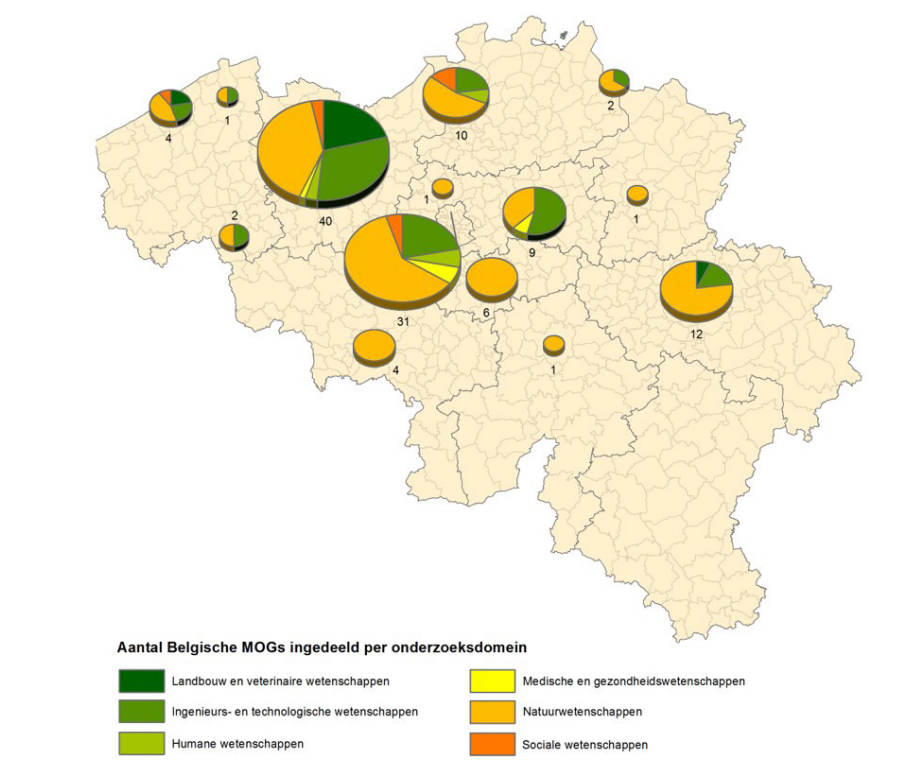
The 2022 inventory demonstrates that there are 136 marine research groups (MRGs) in Belgium. This is a significant increase compared to the 82 MRGs present in the 2013 inventory and approximately 10% more than in 2021. Every year, the MRGs publish between 600 and 900 marine peer-reviewed publications; this figure is comparable to the output of larger marine institutes in the neighbouring countries. Over 73% of these publications are included in open access journals, compared to 40%1 in 2008.
Belgian marine research also has a strong international orientation. In nearly 80% of the publications, the research was conducted outside the Belgian part of the North Sea and 75% were the result of international collaboration (so-called international co-publications). This international collaboration mostly takes place with the neighbouring countries and the US, but the network of our marine researchers covers no fewer than 161 countries. In approximately 26% of cases (2008-2021), a (research) vessel was deployed for data collection, with a total of 338 different (research) vessels from 45 countries.
With this annual update and inventory of the marine research landscape, VLIZ intends to inform marine and maritime (scientific) policymakers, the marine research community and other stakeholders.
3. Most up-to-date citation indicators, calculated on the basis of citations of peer-reviewed VLIZ publications within a timeframe of 3 years, i.e. N-1, N-2 and N-3 for publications from year N-3
These are the Relative Citation Rate (RCR) and the Normalised Mean Citation Rate (NMCR). In addition, the VLIZ publications are also benchmarked by ECOOM against the global standard by means of the Characteristic Scores and Scales (CSS) method.
Mean Observed Citation Rate (MORC)
Mean Expected Citation Rate (MERC)
Relative Citation Rate (RCR)
Subject Mean Expected Citation Rate (MECRIS)
Normalized Mean Citation Rate (NMRC)
Number of citations/number of publications with t=3
Number of citations in journal/number of citations in journal with t=3
MORC/MERC 2,56
Number of citations in the domain/number of citations in the domain with t=3
MORC/MECRIS 3,21
NMRC/RCR 1,26