In 2025, VLIZ launched a unique underwater sound library for the North Sea. With more than 2,000 audio clips, the collection offers insight into the complex soundscape of our busy sea routes. The library shows trends across multiple years as well as differences between locations. In this way, the platform supports policymakers, researchers and the wider public in understanding the impact of human and natural sounds on the marine ecosystem. At the same time, it opens up new opportunities for AI-driven research and encourages further work on underwater sound, which in turn makes an important contribution to the objectives of the recently adopted European Ocean Pact.
In water, sound travels over much greater distances than light, making it an essential tool for many marine animals as they interact with their environment or communicate with others of the same species. All sounds in the marine environment together form the “soundscape”, a landscape that is as rich as it is complex.
Natural sound sources can be abiotic (geophony), such as rain, waves or sediment transport, or biotic (biophony), such as fish sounds or the echolocation of dolphins and harbour porpoises. Human presence at sea is pervasive and introduces sound (anthrophony) into the environment. As activities such as shipping, seismic surveys and offshore energy extraction increase, so too do levels of noise pollution. In the North Sea in particular – a shallow and heavily exploited sea – the mix of all these sound sources makes the soundscape complex to analyse and understand.
A solid understanding of underwater sound at sea is far from a luxury. The European Union recognizes noise as a crucial environmental factor. Under the Marine Strategy Framework Directive (MSFD), underwater noise is one of the eleven parameters used to determine the “good environmental status” of seas and the ocean. For the North Sea, a threshold value of 100 decibels has been set (comparable to the noise of a jet aircraft at an altitude of 300 meters). Keeping noise levels in the North Sea below this threshold is therefore essential to achieving good environmental quality in the region.
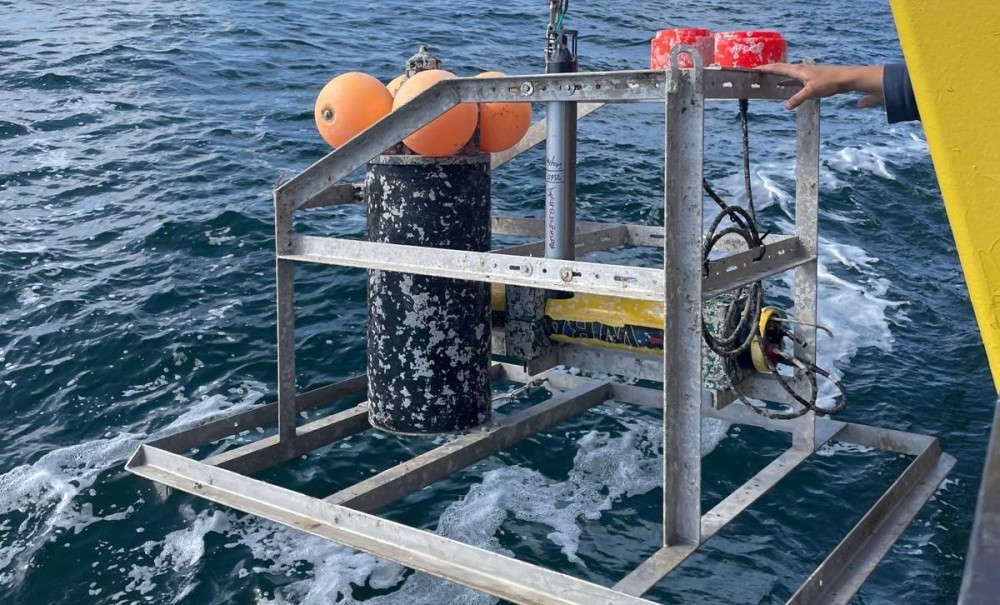
To gain insight into sound in the North Sea, the different sound sources and how they evolve over time, VLIZ is launching a scientifically underpinned sound library. It currently contains 2,000 sound signatures and could eventually grow to 100,000 clips. The sound library consists of a website and an underlying database architecture. To further develop the library, VLIZ has carried out additional field recordings of the underwater soundscape under varying conditions, using an active monitoring system that records underwater sound semi-continuously at fixed locations.
The underwater sound library is more than a collection of sounds from different sources. The platform also makes it possible to visualise trends in underwater noise and to cluster sounds based on their frequencies. It can serve as a basis for training machine-learning models to process sound signals automatically, develop automated applications and enable new research. In addition, the library’s database architecture makes it possible to link sounds to other relevant data, such as AIS data reflecting vessel activity, seabed information, the presence of animals, wind speed, and more.
In the next step, VLIZ aims to connect the underwater sound library to the global library of biological underwater sounds (GLUBS), thereby helping to expand knowledge of known and unknown sounds worldwide. In this way, it provides researchers with the datasets and tools they need to study the marine environment.
The sound library for the Belgian part of the North Sea was developed and expanded by VLIZ, with financial support from the Flemish Government via the cabinet of Jo Brouns, Flemish Minister for Environment and Agriculture. The library is publicly available and allows users to listen to, download and visualise individual sound clips. Alongside conducting research, VLIZ also aims to bring underwater sound closer to the wider public and raise awareness of noise pollution at sea.
Sound library for the Belgian part of the North Sea: marinesoundlib.org