Since its establishment in 2018, the VLIZ Marine Robotics Centre (MRC) has been deploying robots for marine research. The first members of the fleet – ROV Zonnebloem, AUV Barabas, and USV Adhemar – proved their worth, providing VLIZ with both scientific value and crucial operational experience.
In November 2020, USV Adhemar became the first Belgian unmanned vessel to successfully enter and exit a commercial port, operated from a control centre. Although a support vessel was on standby, this campaign marked a crucial milestone in the development of marine robotics in Belgium. The MRC worked closely with the Maritime Rescue and Coordination Centre (MRCC) in Ostend and the Federal Public Service for Mobility and Transport. This unmanned voyage contributed to the creation of a permanent legal framework for unmanned vessels in our country. With the publication of the Royal Decree (RD) on unmanned navigation in Belgian maritime zones on 16 June 2021, Belgium became one of the first countries in the world to have such a framework.
This successful mission sharpened VLIZ’s ambition. The idea emerged to acquire a larger USV that could be deployed autonomously by the MRC in the Belgian part of the North Sea, the VLIZ’s backyard. The vessel needed to meet the following criteria: (1) be large enough to sail stably in short waves, (2) remain easily transportable, (3) be able to conduct continuous sampling at low speed for at least two weeks, and (4) be powerful enough to safely sail from point A to point B in strong currents and winds, in compliance with maritime regulations. The design had to be conceived from the outset for unmanned operation and to avoid suboptimal use. Legislation also played a role. Without clear behavioural rules for USVs, suppliers would not accept liability in the case of incidents. The onboard sensors, network connection, and the remote operations centre had to provide the operator on land with the same decision-making certainty as a skipper on board. This hypothetical vessel – soon named "USV Gobelijn" – was set to evolve into a powerful and versatile mini-research vessel for the North Sea and beyond. That was the plan.
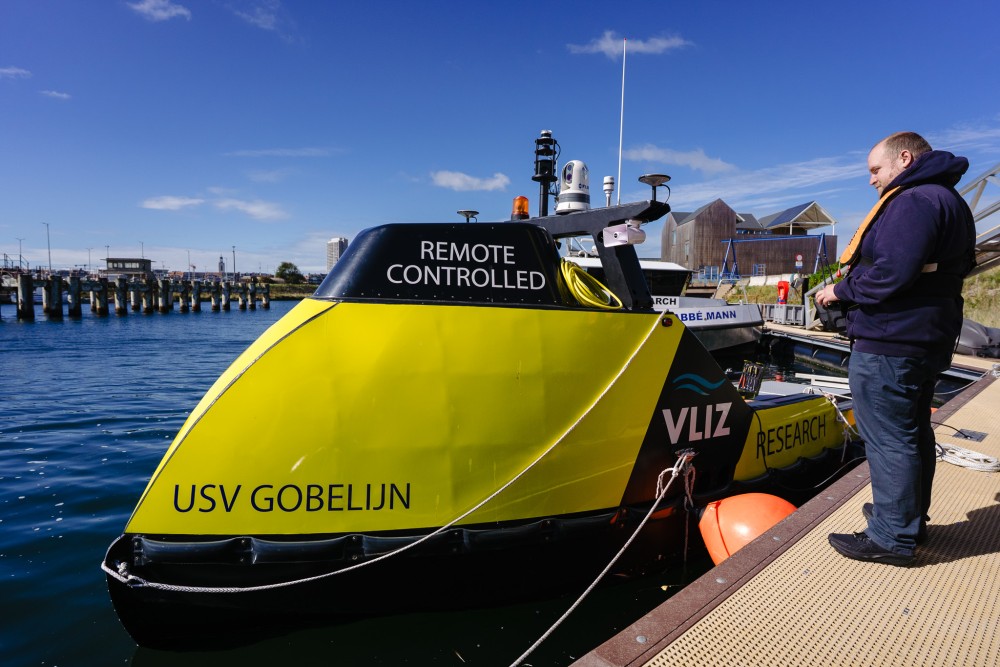
In 2024, support from the Brexit Adjustment Reserve (BAR) allowed the purchase of such a vessel to be realized. Maritime Robotics ultimately won the tender with the Mariner X.
When the USV Gobelijn was delivered in early 2024, the legal framework for unmanned navigation was still limited, and therefore (rightfully) quite restrictive: unmanned operations were permitted on a case-by-case basis, depending on a detailed technical and operational file and a risk analysis. Operations were only allowed in the immediate vicinity of a support vessel, during daylight hours, within a designated area, and under various conditions. In response, VLIZ re-engaged with the relevant authorities. Through exchanging concerns, experiences, and ideas, steady progress was made. Both regulators and users encounter unexpected challenges that only become apparent when theory and technology are tested against the harsh reality of the North Sea.
This collaboration ultimately enabled VLIZ to achieve the following milestones with the USV Gobelijn:
• First nighttime USV operation
• First multi-day USV operation
• Use of Maritime Broadband Radio from land
• Technical modifications to make the support vessel redundant in the future (e.g., directional microphone, additional fire alarms, extra drainage, automatic fuel shutoff in case of emergencies, etc.)
• Presentation of the USV Gobelijn use case at the first North Sea MoU Symposium
Ongoing initiatives:
• USV Gobelijn as a testcase for the RBAT analysis, a recently developed alternative method for evaluating unmanned vessels
• First legally valid USV training
• Deployment of automated obstacle avoidance
• Publication of the tender and Concept of Operations, enabling other operators to use it as a basis
• Upgrade of communication links and cybersecurity
• Upgrade of the remote operating centre
In short, step by step, the USV Gobelijn paves the way for the broader deployment of unmanned vessels.