Since its launch in 2021, VLIZ – with the support of Flanders (Department WEWIS) – has been contributing to the Decade of Ocean Science for Sustainable Development (2021–2030). It does so, for example, through large-scale recognised Decade Actions such as WoRMS within MarineLife2030, Marine Regions, and the Sea Level Station Monitoring Facility within the Tsunami Program.
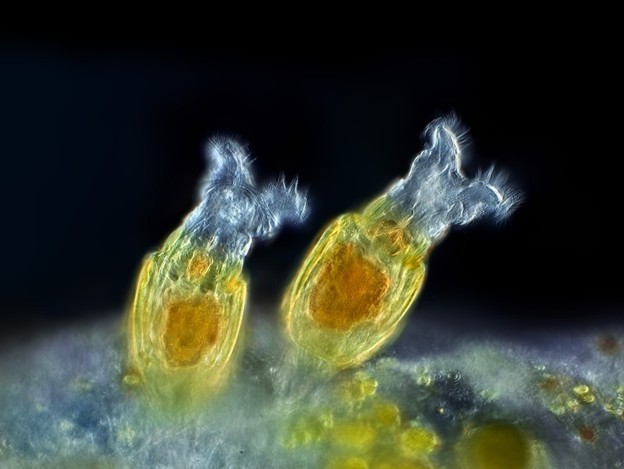
In 2025, the World Register of Marine Species (WoRMS) once again published its traditional list of the 10 most remarkable new marine species. WoRMS also released a global checklist of Myxozoa (a group of more than 3,000 species of obligate parasites belonging to the cnidarians), and the Rotifer World Catalogue (RWC) is now part of WoRMS. Under the WoRMS umbrella, PeRMS was launched in 2025: the Peruvian Register of Marine Species, an updated list of species living in waters under Peruvian jurisdiction. In September 2025, taxonomy experts from VLIZ’s sister institute INVEMAR (Colombia) visited the InnovOcean Campus. Together with WoRMS and Marine Regions, they worked on a national register of marine species for Colombia. After 17 years of service at VLIZ, Wim De Cock, a member of the WoRMS Data Management Team, retired – well deservedly.
As a recognised Decade Action, the Sea Level Station Monitoring Facility (SLSMF) aims to further increase the uptake and use of ocean knowledge. By providing quality-controlled data to all National Tsunami Warning Centers (NTWCs) and Regional Tsunami Service Providers (TSPs), it supports the expansion of observing systems and strengthens monitoring in tsunami-prone areas, particularly in the least developed countries and in small island developing states. One example of the importance of the SLSMF is the earthquake of 29 July 2025 near Kamchatka, with moment magnitude (Mw) of 8.8. The impacts of the subsequent tsunami could be tracked across the entire Pacific Ocean through the SLSMF, with event mode activated on multiple DART buoys. In addition, many tide gauges recorded sea-level changes during the event. The Kamchatka tsunami once again highlighted how vital it is to share real-time sea-level data in order to improve coastal safety and reduce disaster risk.
As part of its annual synchronisation process, Marine Regions incorporated the latest updates from the name registers of GEBCO and ACUF in 2025. This integration added 108 new undersea features in total: 107 from GEBCO and 1 from ACUF. With these updates, Marine Regions continues to provide the most up-to-date and authoritative information on the names of undersea features. By maintaining regular alignment with these sources, Marine Regions preserves consistency across marine datasets and supports accurate referencing worldwide.
VLIZ also coordinates the Flemish and Belgian contribution to the Ocean Decade through the Belgian National Decade Committee (NDC-BE). In addition, VLIZ is one of the eleven globally recognised Decade Implementing Partners (DIP). The institute has earned this recognition through its commitment to supporting the Ocean Decade by coordinating actions, catalysing initiatives, leading targeted communication and outreach, and mobilising resources. VLIZ philanthropy, recognised as a Grant Making Facility in support of the Ocean Decade, works closely with VLIZ as a Decade Implementing Partner – on Flemish contributions (e.g. via FUST) and on the action lines of the Belgian National Decade Committee – in consultation with the Decade Coordination Unit at the IOC headquarters in Paris.
Finally, in 2025 the book ‘De Onbekende Zee’ by Jan Mees and Colin Janssen, which brings together the latest insights from marine science and combines clear analysis with an urgent call to action, was published in English. ‘The Unknown Sea’ has been officially recognised as an Ocean Decade Activity within the UN Decade, underlining the societal and scientific importance of this work.