With the publication of the Third World Ocean Assessment, the United Nations has released the most comprehensive evaluation ever undertaken of the state of the global ocean. The verdict is clear: the ocean provides food, oxygen and climate regulation, yet it is facing growing pressure worldwide. The report not only highlights the challenges but also identifies pathways towards a more sustainable future. Hundreds of scientists from more than 80 countries contributed the latest knowledge on biodiversity, climate change, pollution and sustainable ocean management. The chapter on marine biodiversity drew on data and expertise from the World Register of Marine Species (WoRMS), Marine Regions and the Ocean Biodiversity Information System (OBIS) – all coordinated from Ostend, Belgium, and supported by VLIZ.
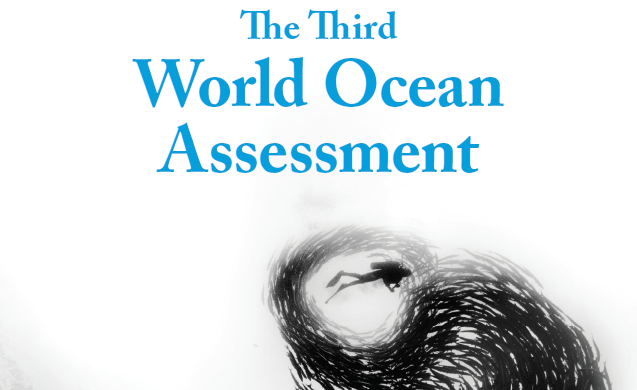
When the United Nations launched the third edition of the World Ocean Assessment (WOA III) on World Ocean Day, 8 June 2026, it marked far more than the release of another scientific report. WOA III is the only global, integrated assessment that brings together the ecological, economic and social dimensions of the ocean. The result is a scientific compass designed to help policymakers protect and sustainably manage the ocean.
WOA III is the outcome of an impressive international collaboration. Around 550 scientists from more than 80 countries spent several years assessing the state of the ocean. Their mission was to synthesize the latest scientific knowledge on changes in the marine environment and their implications for nature and society.
An ocean under pressure
The findings are clear. Climate change, pollution and increasing human activities at sea are placing the ocean under increasing pressure. Ocean warming, acidification, biodiversity loss and habitat degradation are occurring across virtually all ocean basins. The consequences extend far beyond the marine environment, affecting fisheries, coastal protection, food security and human health.
According to the United Nations, some marine ecosystems are approaching critical tipping points. Reliable scientific information is therefore essential to support timely and effective action. WOA III provides policymakers with a robust scientific foundation for decisions on ocean governance, conservation and the sustainable use of marine resources.
More than an update
Building on previous assessments published in 2015 and 2021, WOA III goes beyond simply reporting on the state of the ocean. For the first time, issues such as ocean governance, equity, gender, local knowledge and Indigenous knowledge are given a prominent place. The report also explores potential pathways towards a more sustainable future.
The format itself has evolved as well. Alongside the report, the United Nations launched an interactive online platform where users can explore chapters, datasets and regional information. This makes the wealth of knowledge generated by WOA III more accessible to policymakers, researchers, students and the wider public.
Biodiversity as a foundation
A key component of WOA III is its chapter on marine biodiversity. This is hardly surprising: the ocean contains most of the Earth's biodiversity and provides essential ecosystem services on which humanity depends.
The chapter draws on international data infrastructures that document marine species and their distributions worldwide. In particular, the World Register of Marine Species (WoRMS), the Ocean Biodiversity Information System (OBIS) and Marine Regions collaborated on one of the biodiversity chapters. Their contribution highlights the growing importance of high-quality marine data infrastructures in global ocean assessments. Coordinated from Ostend and supported by VLIZ, WoRMS, OBIS and Marine Regions provide authoritative taxonomic and geographic reference systems that underpin marine research and policy worldwide.
From knowledge to action
Perhaps the most important message of WOA III is that science has already generated the knowledge needed to support meaningful and sustainable action. The challenges are significant, but the report also demonstrates that solutions exist when governments, scientists, businesses and citizens work together. The question is no longer whether we understand what is happening in the ocean, but how quickly we can translate that knowledge into policies and actions that safeguard its future.
> Explore the WOA III online platform