Michiel Perneel’s PhD research at the Flanders Marine Institute (VLIZ), the Flanders Institute for Biotechnology (VIB), and Ghent University used advanced genetic techniques to uncover what plankton are actually doing in the Belgian North Sea. By applying metatranscriptomics – which reveals which genes are active at a given moment – he tracked the daily and seasonal activities of microscopic organisms that drive marine ecosystems and oxygen production. His findings show that different plankton species thrive under distinct environmental conditions and play specialized roles in the food web. In particular, his work on the algae Phaeocystis globosa linked changes in gene activity to real-time oxygen production during spring blooms. The study establishes a new way to monitor ocean health and understand how these tiny organisms respond to climate and nutrient changes.
Plankton may be microscopic, they are giants in their influence. They form the foundation of marine food webs and produce a large share of the oxygen we breathe. Yet what plankton are actually doing in the ocean from moment to moment has remained largely hidden. This week, Michiel Perneel, researcher at the Flanders Marine Institute (VLIZ), the Flanders Institue of Biotechnology (VIB), and Ghent University, defended a PhD that opens an unprecedented window into the daily lives and ecological roles of plankton in the Belgian part of the North Sea.
To achieve this, Michiel relied on an advanced molecular technique called metatranscriptomics, which detects which genes are active inside plankton cells. Instead of merely identifying which organisms are present, the method also shows what they are busy with at the moment of sampling: whether they are growing, hunting, photosynthesising, or coping with environmental stress.
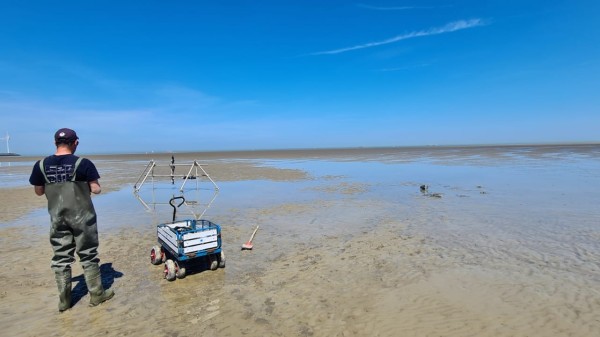
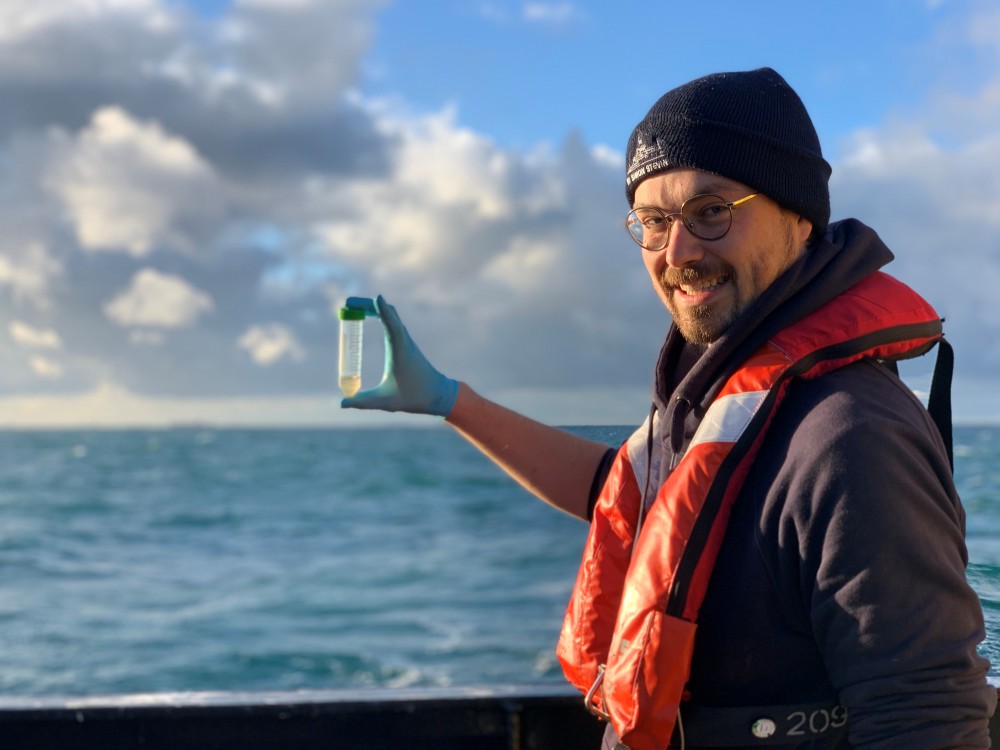
Over three years, from July 2020 to August 2023, he collected monthly seawater samples and extracted RNA to reveal these snapshots of cellular activity. The result is one of the most detailed and long-term datasets of plankton gene expression ever generated for the coastal North Sea. It establishes metatranscriptomics as a valuable and realistic tool for monitoring marine ecosystems, and the full dataset will be made publicly accessible for further exploration and research.
Diverse plankton strategies in a changing coastal environment
The work shows that not all plankton thrive in the same conditions. Even within the small stretch of the Belgian North Sea, the coastal waters seem far from uniform. Some regions are influenced by river inputs and are rich in nutrients, while others farther offshore are clearer and saltier. Michiel’s research demonstrates that different plankton species have evolved distinct metabolic strategies that allow them to succeed in particular environments. Some species flourish where nutrients are plentiful, others grow best in clearer waters with more light, and still others survive by feeding on other plankton.
These differences have broader implications: the identity of plankton species influences how successful fish larvae can feed on them and thus shapes the larger marine food web. Understanding which plankton are present and what they are actually doing at the moment of sampling , not just how many, is therefore crucial for predicting how coastal ecosystems will respond to climate change and to shifts in nutrient levels.
Linking algal gene activity to ecosystem oxygen production
One striking part of the research focused on the annual spring bloom of the algae Phaeocystis globosa, famous for turning parts of the North Sea into a bright, milky green colour that can even be seen from space.
During one of these blooms Michiel and colleagues sampled seawater every hour to trace how the algae’s genetic activity changed throughout the day. By combining this information with measurements of oxygen production, they were able to directly link the microscopic processes inside algal cells to the large-scale production of oxygen in the ecosystem. This provides rare and valuable evidence of how much oxygen and carbon such blooms contribute to the environment, helping scientists better estimate the role of these tiny organisms in global biogeochemical cycles.
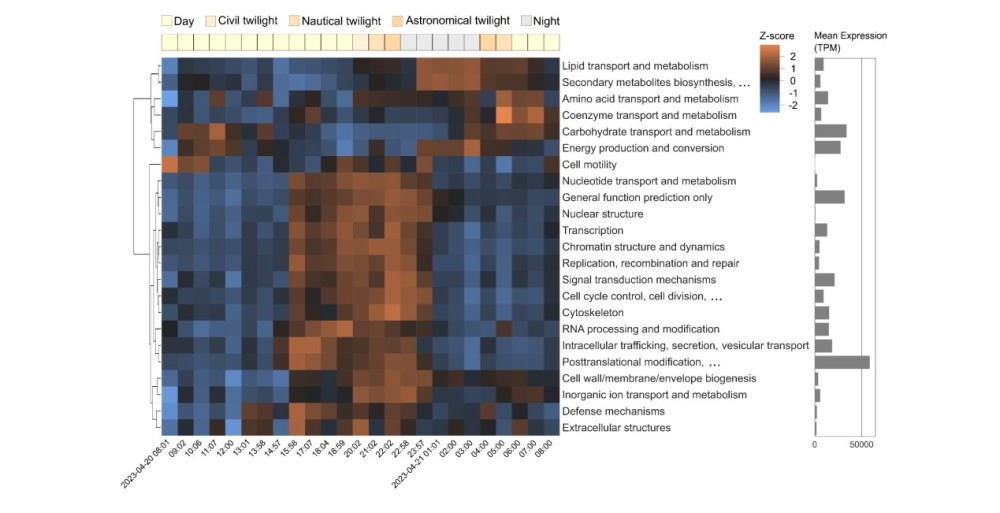
This colour-coded graph shows which genes in Phaeocystis globosa were turned up or down in activity – relative to normal levels – at each hour of a 24-hour cycle, grouped by their functions and similarity to genes in other organisms.
Taken together, this research shows that the North Sea is not a static environment, but a dynamic living system in which microscopic communities respond to tides, seasons, and broader environmental changes. It highlights the importance of studying plankton not just as background organisms, but as active, influential players in the functioning of our coastal seas.
As climate change continues to reshape marine environments, tools that reveal what is happening at the level of individual cells, like the ones used in this PhD, will be crucial. Michiel’s work provides both a new understanding of plankton ecology and a powerful way to continue observing the ocean’s invisible yet essential life. VLIZ warmly congratulates him on obtaining his degree of Doctor of Science: Bioinformatics.
PhD and supervision
Michiel Perneel's PhD was carried out at the Flanders Marine Institute (VLIZ), the Flanders Institute for Biotechnology (VIB) and Ghent University (Department of Plant Biotechnology and Bioinformatics). He did so under the supervision of his supervisors Pascal Hablützel (VLIZ & VUB) and Steven Maere (UGent & VIB). The jury for the public defence consisted of Prof. Natalie Cohen (University of Georgia), Prof. Thomas Mock (University of East Anglia), Prof. Eveline Pinseel (Ghent University), Prof. Jeroen Raes (VIB) and Prof. Koen Sabbe (Ghent University). Michiel received support from FWO-Flanders to carry out this research.
Reference: Perneel, M. (2025). Spatiotemporal metatranscriptomics of surface microeukaryotic plankton communities in the Southern North Sea. PhD Thesis. Ghent University – Department of Plant Biotechnology and Bioinformatics/Flanders Marine Institute: Gent, Oostende. 313 pp. [VLIZ library]