News

Blue economy Technology & innovation

Multidisciplinary approach and international collaboration are strengths of Belgian marine research

12/04/2025 - 08:47
Between 2008 and 2024, Belgian universities and research institutes published between 447 and 974 peer-reviewed papers each year, across 2,006 different scientific journals. This output is on a par with the larger marine institutes in our neighbouring countries. A growing share of these papers is open access, rising from about 34% in 2008 to a provisional high of 79% in 2023.
Sea & health

Removing plastics from aquatic environments: challenges and opportunities

12/03/2025 - 14:00
Plastic pollution remains one of the most pressing social and environmental challenges worldwide. In response, a range of mitigation strategies have been implemented including policy interventions and legislative frameworks, the development of alternative materials, and technological innovations aimed at removing existing plastics from the environment. In her PhD thesis defended on December 3 2025...
Technology & innovation

European Digital Twin Ocean enters new phase to strengthen open collaboration across the marine community

11/25/2025 - 14:40
The European Digital Twin Ocean, a flagship EU initiative turning ocean data into actionable knowledge, has entered its second phase with a €14 million investment. Led by Mercator Ocean International and the Flanders Marine Institute (VLIZ) on behalf of the European Commission, this new stage — known as EDITO2 (2025–2028) — will both enhance the platform’s technological capabilities and expand co...

VLIZ Marine Science Day 2026 opens call for abstracts

11/24/2025 - 15:06
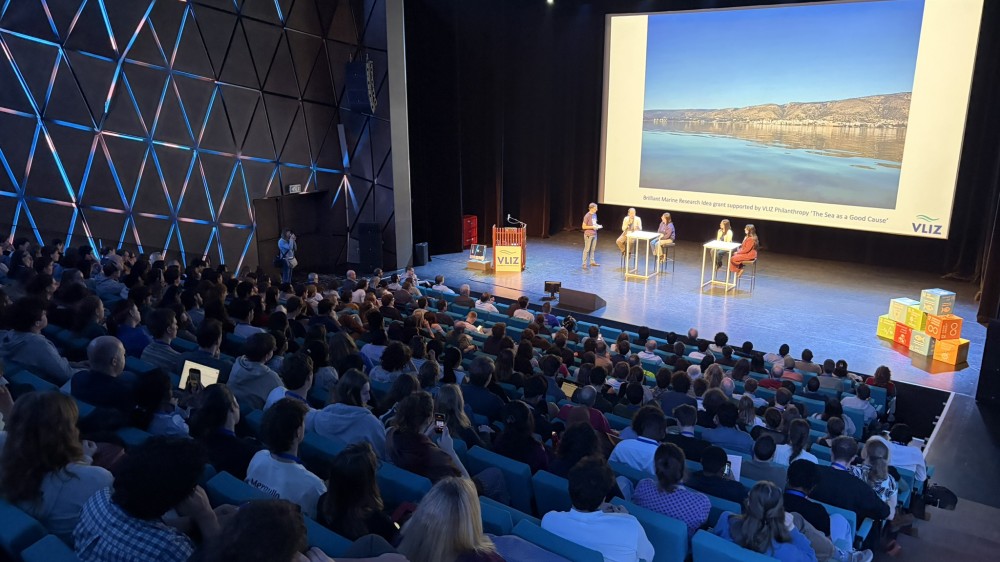
VLIZ invites researchers to present their work at the VLIZ Marine Science Day 2026, either through a short pitch or a poster. The event will take place on Wednesday 4 March 2026 at De Grote Post in Ostend. This year’s edition focuses entirely on internationalisation and offers a dynamic programme featuring inspiring presentations and interactive moments. In addition, visitors will be able to...
Climate

Techniques for carbon dioxide removal by the ocean: need for monitoring, reporting and verification

11/18/2025 - 09:49
The latest publication from the European Marine Board takes a clear stance on the potential of today’s ocean-based approaches for extracting CO₂ from the atmosphere — known as marine Carbon Dioxide Removal (mCDR). An analysis of the most prominent ocean-based methods shows that none of them currently provide a viable alternative to cutting emissions at the source. Rapid reduction of CO₂ emissions...
Climate

Fossil fuel CO2 emissions hit record high in 2025

11/12/2025 - 16:34
Global carbon emissions from fossil fuels are projected to rise by 1.1% in 2025 – reaching a record high, according to new research by the Global Carbon Project. The 2025 Global Carbon Budget projects 38.1 billion tonnes of fossil carbon dioxide (CO 2) emissions this year. Decarbonisation of energy systems is progressing in many countries – but this is not enough to offset the growth in global...

VLIZ report highlights knowledge transfer between marine sciences and policy

11/06/2025 - 12:22
A new VLIZ report, commissioned by the Sustainable Blue Economy Partnership, maps out key opportunities and strategies to improve communication between marine scientists and policymakers. The publication Advancing knowledge exchange at the marine science-policy interface – An assessment of current tools and strategies offers a comprehensive four-chapter analysis of current best practices...
The sea before

Ancient barrier-island system discovered off the Belgian coast

11/05/2025 - 15:33
A system of barrier islands existed off the central Belgian coast around 4,000 BC. Much like the Dutch Wadden Sea today, this long-lived coastal system comprised sandy islands fronting a mosaic of tidal flats and marshes. The once-famous island of Testerep appears to have been part of this system. It began to vanish from around AD 500, for reasons that remain unknown, while the currently existing...
Biodiversity Climate Sea & health

How plankton shapes the North Sea

11/04/2025 - 11:18
Michiel Perneel’s PhD research at the Flanders Marine Institute (VLIZ), the Flanders Institute for Biotechnology (VIB), and Ghent University used advanced genetic techniques to uncover what plankton are actually doing in the Belgian North Sea. By applying metatranscriptomics – which reveals which genes are active at a given moment – he tracked the daily and seasonal activities of microscopic...
Biodiversity Blue economy Climate Technology & innovation Sea & health

The Sea as a Good Cause supports fresh approaches to marine research

10/27/2025 - 11:49
The philanthropic arm of VLIZ – The Sea as a Good Cause – continues to support young, creative marine researchers. This year, six research grants will be awarded again to PhD students and junior postdocs working in Flanders, as well as to doctoral students from the Global South. Key requirement: dare to think differently, dare to be innovative. Submit your proposal by 19 January 2026.
Sea & health

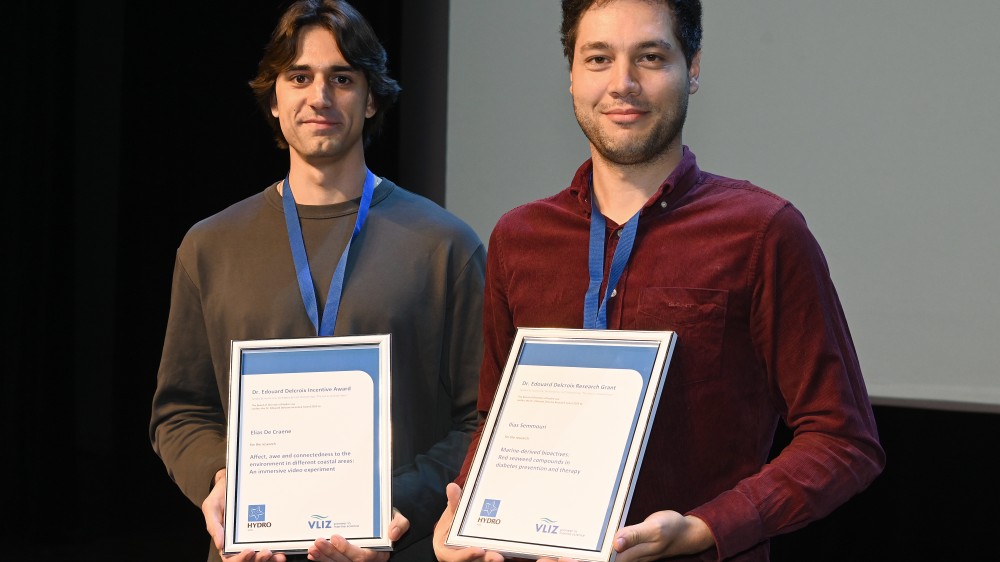
Ocean and Health: Research Recognised with the Dr. Edouard Delcroix Awards

10/21/2025 - 16:58
Hydro vzw and The Sea as a Good Cause (the philanthropic project of VLIZ) present the prestigious Dr. Edouard Delcroix Research Grant and Incentive Award to scientists working within the broad field of the interaction between the ocean and human health. Would you like to participate? Submit your application before 19 January 2026.
The sea before

IKUWA8: 8th International Congress for Underwater Archaeology in Oostende

10/17/2025 - 15:42
From 13 to 17 October 2025, Ostend was immersed in maritime history as it hosted IKUWA8, the eighth world congress on underwater archaeology, under the central theme 'Telling the Exciting Tales of Our Past'. Four hundred researchers, policymakers, and heritage managers from 50 countries gathered in De Grote Post to explore the richness of the 'blue heritage'. From centuries-old shipwrecks to...
Biodiversity Blue economy

Oyster larvae listen, smell and feel their way to a new reef

10/13/2025 - 13:57
For young oysters, finding the right place to settle is literally a matter of life and death. Their transition from free-swimming larvae to permanently attached adults is guided by a wide range of environmental cues. In her recently defended doctoral research, Sarah Schmidlin demonstrates that the Pacific oyster ( Magallana gigas ) uses not only chemical signals but also underwater sounds and...

GEORGE Technical Forum on sensors at the Marine Station Ostend

10/06/2025 - 12:02
From 6 to 10 October 2025, the second onsite training session of the GEORGE project ‘Technical Forum II: Sensors’, takes place at the Marine Station Ostend of VLIZ. The event brings together technicians, engineers and scientists from European marine research infrastructures.
Technology & innovation

SoundLib: the marine sound library for the North Sea

09/16/2025 - 15:09
The Flanders Marine Institute (VLIZ) has launched a unique underwater sound library for the North Sea. With more than 2000 sound clips, this collection offers insight into the complex soundscape of our busy sea. The library highlights trends across different years and variations between locations. In doing so, the platform supports policymakers, researchers, and the wider public in understanding...
Technology & innovation

King Filip and Queen Mathilde visit the Flanders Marine Institute

09/16/2025 - 14:43
On Tuesday 16 September, Their Majesties King Filip and Queen Mathilde visited the Flanders Marine Institute (VLIZ) in Ostend. Their visit formed part of a provincial tour of West Flanders, centred on the theme of “safety at the North Sea.” At VLIZ, the focus was on the latest insights in marine research and the innovative technologies employed by scientists.
Technology & innovation

Revealing the Deep: VLIZ and Seabed 2030 build a complete map of the ocean floor

09/02/2025 - 16:15
Our planet is more than 70% ocean, yet much of the seafloor remains a mystery. The international Seabed 2030 Project, an initiative of The Nippon Foundation and GEBCO, is determined to change that. Its goal: by 2030, to deliver a complete, freely accessible map of the entire ocean floor. This is more than a scientific dream; a detailed seafloor map is vital for applications such as improved...