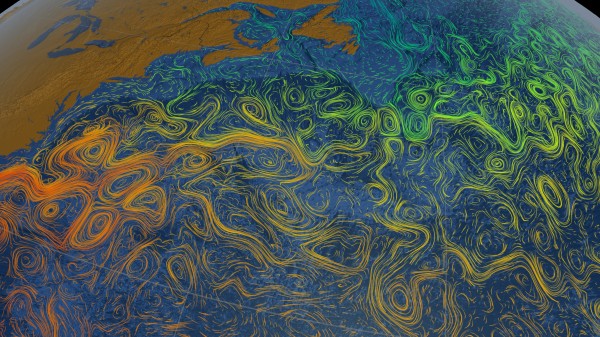
The Arctic Ocean is changing rapidly, with consequences that are expected to extend far beyond the polar region. Over the coming months, and within the context of E(ddies)GC project, researchers from the Flanders Marine Institute (VLIZ) will lead an international research effort to better understand one of the least explored drivers of polar climate: swirling ocean currents known as eddies. Combining international expertise with autonomous underwater gliders, surface drifters, ship-based observations and satellite measurements, the project aims to uncover how ocean eddies influence the East Greenland Current (EGC).
The East Greenland Current is a key current in the Arctic Ocean. It transports cold, fresh water and sea ice equatorward, playing an important role in the Atlantic Meridional Overturning Circulation (AMOC) - the broad system of ocean currents that regulates Earth's climate. Yet many of the smaller-scale processes that influence this circulation remain poorly understood, particularly the role of eddies: rotating bodies of water that modulate the variability in the current’s domain and influence the transport of heat, salt, and nutrients.
One of the campaign's most innovative aspects is its adaptive sampling strategy. Rather than following a fixed survey plan, scientists will continuously adjust both vessel operations and glider missions based on near-real-time observations from the Surface Water and Ocean Topography (SWOT) satellite. By tracking the location and evolution of ocean eddies and the East Greenland Current from space, the team can direct their instruments towards the most scientifically valuable targets as they develop, maximising the impact of every observation collected at sea.
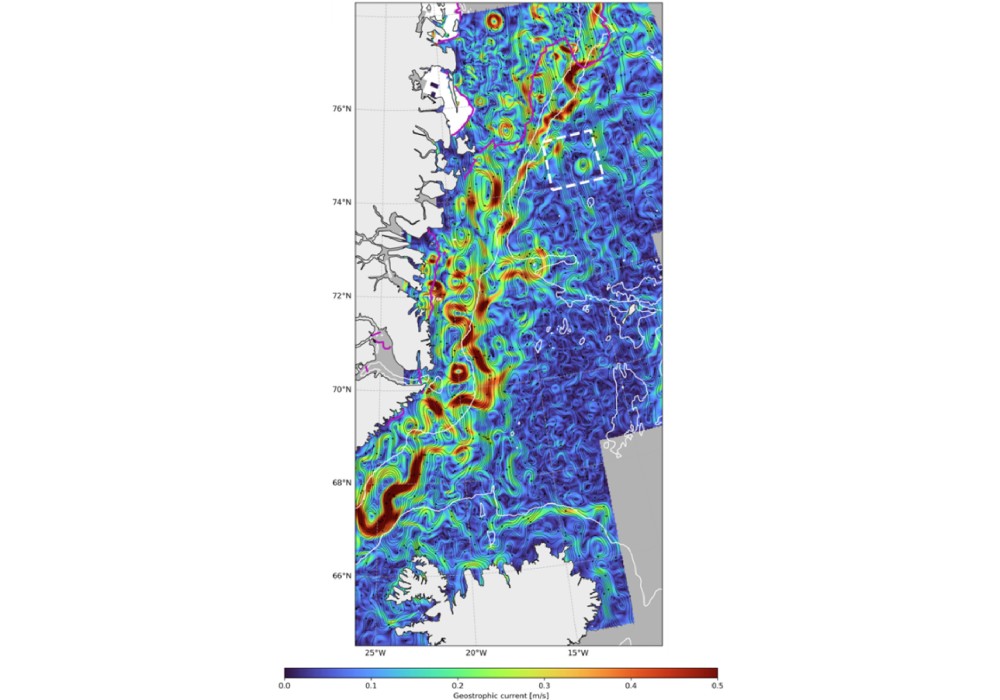
Ocean circulation patterns in the East Greenland Current and interacting eddies derived from satellite observations. (Image from Jensen et al., 2025).
At this moment, the team from the VLIZ Marine Robotics Centre is onboard the Norwegian icebreaker RV Kronprins Haakon and will deploy VLIZ’s two autonomous gliders, Yoko and Tsuno, over the next few days. These autonomous underwater vehicles can remain at sea for weeks, silently collecting detailed measurements of, among others, temperature, salinity and ocean currents while travelling hundreds of kilometers beneath the surface. Throughout their mission, Yoko and Tsuno will be piloted remotely by the Marine Robotics Centre team from the VLIZ headquarters in Ostend.
The campaign culminates between 25 August and 3 September 2026, when VLIZ coordinates the multidisciplinary Aquarius E(ddies)GC field campaign aboard the Icelandic research vessel RV Þórunn Þórðardóttir (read: Thorunn Thordardottir). Other project partners involved in the campaign are the University of Bergen (UiB), Technical University of Denmark (DTU), Danish Meteorological Institute (DMI), Università degli Studi di Napoli Federico II (Unina), Università degli Studi di Napoli Parthenope (Uniparthenope), Université catholique de Louvain (UCLouvain), Institute of Oceanology Polish Academy of Sciences (IOPAN), SCRIPPS Institution of Oceanography, and the Marine and Freshwater Research Institute (HAFRO). During this intensive period, the research team will recover the two gliders while carrying out a comprehensive programme of observations designed to characterise key properties of both eddies and the East Greenland Current, including physical properties, biogeochemistry, carbon-related parameters, microplastics, and aerosols.
Do you want to know more about the E(ddies)GC project?
Contact principal investigator Leandro Ponsoni (VLIZ Marine Robotics Centre).
E(ddies)GC is supported by AQUARIUS which received funding from the European Union’s Horizon Europe Framework Programme for Research and Innovation under grant agreement No 101130915. Additional funding was provided by the Departement Kanselarij en Buitenlandse Zaken (DKBuZa) from Flemish government through DKBuZa Nordic initiative. We also acknowledge the Global Drifter Program of SCRIPPS.