The Flanders Marine Institute (VLIZ) plays a leading role in Europe in measuring CO2 at the ocean surface, and is taking on the coordination of the European hub of the so-called Surface Ocean CO₂ Atlas (SOCAT). This EU hub was recently established to better coordinate the annual updates of the SOCAT synthesis products and to support SOCAT. The EU hub a.o. provides statistics for SOCAT, tracks publications using SOCAT, and maintains the SOCAT website.
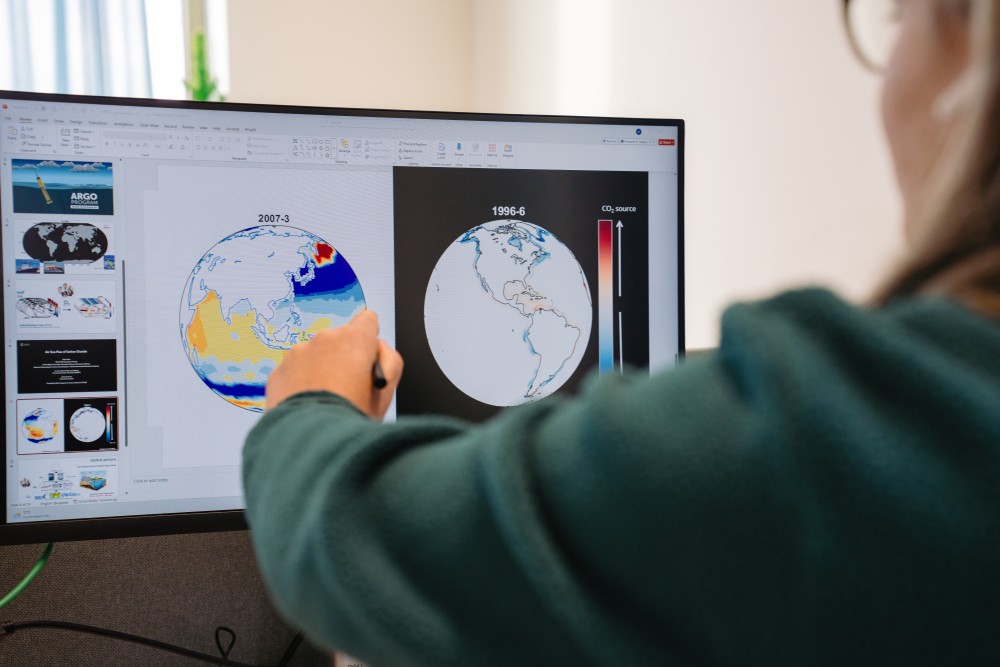
Climate change is one of our biggest challenges, with the ocean at its heart. The ocean acts as the ultimate climate regulator by absorbing about 90% of the excess heat from greenhouse gas warming and about 25% of annual anthropogenic CO2 emissions. To how much CO2 increase this exactly leads in the surface waters and how that varies per region and over time, is still not fully clear yet. In situ measurements made on that immense ocean – covering 71% of our planet – are not too numerous and not yet covering the full surface area.
A group of more than 100 international marine carbon researchers brings together all available (since 1957) in situ measurements made by ships, buoys, autonomous and floating platforms in the community-led Surface Ocean CO2 Atlas (www.socat.info). SOCAT is a core data product of the Global Ocean Observing System for biogeochemistry, approved by the Global Ocean Observing System GOOS. Since the start of this database in 2007, more and more data has been collected in it, and both its accuracy and quality control have only improved since then. SOCAT-based data products (such as the Global Carbon Budget) are used to quantify the carbon sink and ocean acidification, and to evaluate sensor data and biogeochemical models. The data also finds its way into climate models that provide key information to policymakers in climate negotiations about the ocean's uptake of CO2.
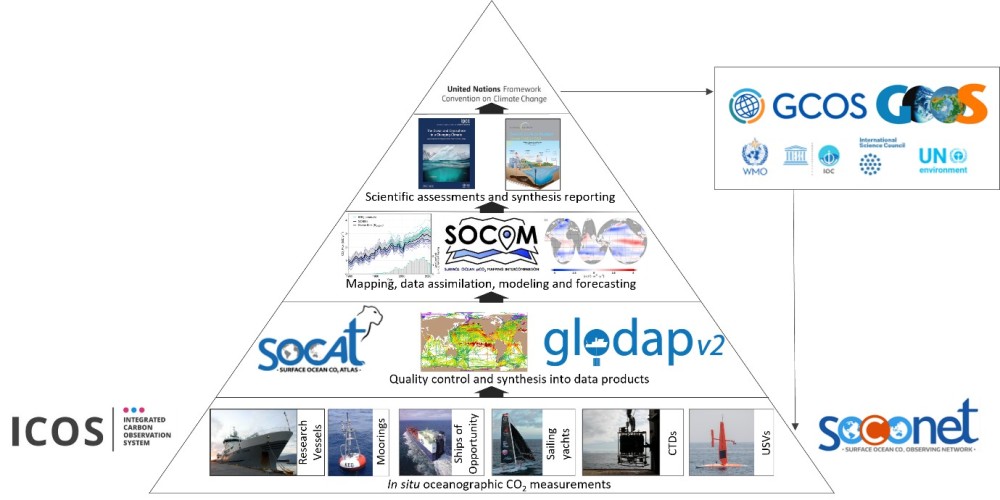
Illustration of the carbon value chain from observations, through databases and mapping, to high impact assessments. Modified from Guidi et al. (2020) Big Data in Marine Science. EMB Future Science Brief 6, doi:10.5281/zenodo.3755793
SOCAT is coordinated via a Global Group and a number of hubs, and gets additional support from regional groups and data contributors. The SOCAT global group acts as the decision-making body of SOCAT and consults SOCAT contributors on strategy and quality standards. The current global group has a chair and 10 (data) scientists from seven countries on two continents. On top of that there is a North American and a European hub. The US hub is led by NOAA PMEL/University of Washington, responsible for running and maintaining the software and IT infrastructure required for SOCAT (meta-)data submission, quality control, and publication of SOCAT synthesis products. The European hub has the Flanders Marine Institute (VLIZ) as its leading institute. This hub has been newly created to coordinate annual updates to the SOCAT synthesis products and support SOCAT, via the organisation of meetings and training events, support for data upload, quality control (QC), and the SOCAT leadership, and coordination with the Global Carbon Project. This hub provides statistics for SOCAT, track publications using SOCAT, and maintain the SOCAT website.
The CO2 measurements that VLIZ has been carrying out since 2015 with the research vessel RV Simon Stevin and the measuring buoy at the Thornton Bank, in the framework of the Integrated Carbon Observation System (ICOS), also contribute to the SOCAT atlas. The quality and global significance of VLIZ’s work were further recognized by the IPCC, which nominated Peter Landschützer – VLIZ research director and head of the PPFC group – as a lead author for the 7th Assessment Report.